
Digital and data
Standards open doorways in the digital economy.
On this page
Technology touches every part of our world – the way we live, learn, work and socialise. The changing environment of the digital economy is rapidly adopting and innovating new technologies that present many opportunities and challenges. In our hyperconnected world, the security of our information has never been more crucial.
Establishing good practice will be fundamental to succeeding in a data-driven, digitally connected world. Standards help organisations make sense in a complex industry, providing consensus-built, agreed tools and ways of doing things that allow global interoperability, security and innovation to flourish.
The digital economy is the third largest contributor to New Zealand’s economy, and standards play a critical role in supporting New Zealand Tech businesses’ success.
"With New Zealand being such a long distance from trading partners there is a need for strong IT systems that are trusted and can integrate seamlessly and reliably with other countries. Standards ensure interoperability." — Alison Holt, International data standards committee member, IT Professionals NZ Board member, business entrepreneur and academic.
"We are unrecognizable to a global market without standards. We don’t win work because of standards and compliance. But without them we do lose." — Andy Prow, CEO RedShield cybersecurity.
[Visual: The video begins with a series of clips showing Auckland. Then a series of concurrent clips around 2 seconds each follow showing graphical interpretations of digital communications, technology being used including bio metrics, CCTV and x-rays and people talking while using computers, and mobile phones with narration overlaid.]
Narrator: Almost every organisation in New Zealand depends on digital systems from websites, email communications and electronic payments to data management, AI integration, cloud storage and digital trade. All of which are critical to how we operate and grow as an economy.
With digital systems come new risks. Cyber threats and data breaches are evolving. AI is advancing faster than governance frameworks and regulation. Data is moving across organisations borders and platforms. Without proven and consistent approaches, risk increases and trust breaks down.
Digital standards turn best practice into repeatable practice. They provide structure and specificity across security, privacy, authentication, data management, biometrics, and AI. So, organisations don't have to design solutions from scratch.
For organisations managing risk, standards provide clear, internationally recognised, and trusted guidance.
[Visual: A woman appears on screen in an office environment.]
Maria Robertson, Chair of Digital Identity New Zealand says, "Well, when an organisation relies on an internal framework rather than an international body of knowledge like a standard, it means that actually they can suffer from bias or blind spots. Having frameworks and parameters like standards actually provide some confidence that there are some guard rails for people and that they can rely on those to keep them safe, their family's data safe and ultimately their identities safe."
[Visual: The video returns to brief graphical interpretations of digital communications, technology being used including bio metrics and people using computers, and mobile phones with narration overlaid.]
Standards also create interoperability, allowing systems, data, and organisations to work together seamlessly. And they support assurance, enabling organisations to demonstrate compliance, security, and trust to customers, regulators, and business partners.
[Visual: A woman appears on screen in an office environment.]
Monica Greenan, General Manager at Government Digital Delivery Agency says, "So standards for digital technologies are fundamental to delivering tailored joined up services for New Zealanders. They provide a shared foundation that help agencies design services that are secure, accessible, reliable, and trusted."
[Visual: The video returns to brief graphical interpretations of digital communications, technology being used including bio metrics and people using computers, and mobile phones with narration overlaid.]
Narrator: Far from limiting innovation and emerging technologies, standards enable it. They reduce uncertainty, accelerate adoption of technologies like AI, quantum computing, and cloud storage and make it easier to scale securely. At a national level, standards support secure digital trade, stronger interoperability, and greater global competitiveness.
[Visual: A woman appears on screen in an office environment.]
Madeline Newman, AI Executive Director at AI Forum New Zealand says, "If you're dealing with personal private information, sensitive information, or if you're dealing internationally with organisations that may not even know where New Zealand is or may not know who your company is, they at least have this basic standard that they understand that you meet. That can be really important. That's the difference between getting a deal and not getting a deal."
[Visual: The video returns to brief graphical interpretations of digital communications, technology being used including bio metrics and people using computers, and mobile phones with narration overlaid.]
Narrator: In a digital economy, trust and consumer confidence is critical. Standards provide the foundation for that trust, enabling innovation, protecting systems, and driving competition, growth, and innovation.
From new startups to established global businesses, good practice starts with digital standards. Discover digital technology standards at standards.govt.nz.
[Visual: The video closes with a view of Wellington and the logo for Standards New Zealand, MBIE and NZ Government.]
Benefits across the digital sector
Regulators
Standards provide harmonised solutions that establish a solid technical base that can be used to write and implement ICT-related policy, and help develop technologies that directly benefit them on issues such as identity management and information security.
Industry
Aligning to New Zealand and international standards supports businesses to operate digitally worldwide – from protecting reputation, integrity and market credibility, to providing customer and business partner confidence and integrating technology for competitive advantage.
Consumers
Consumers benefit from state-of-the-art devices, better-performing systems, and organisations that work more effectively. What’s more, consumers enjoy increased protection of their personal data thanks to the advances in information security achieved through standards.
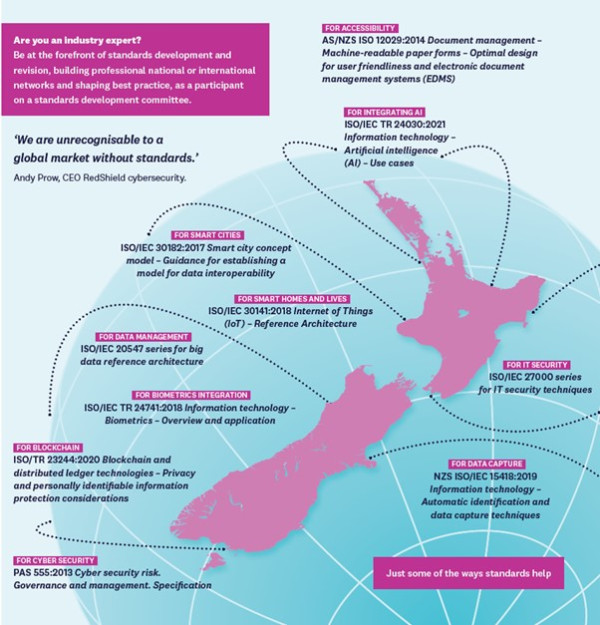
Are you an industry expert?
Be at the forefront of standards development and revision, building professional national or international networks and shaping best practice, as a participant on a standards development committee.
‘We are unrecognisable to a global market without standards.’ - Andy Prow, CEO RedShield cybersecurity.
Just some of the ways standards help:
- For accessibility - AS/NZS ISO 12029:2014 Document management – Machine-readable paper forms – Optimal design for user friendliness and electronic document management systems (EDMS)
- For integrating AI - ISO/IEC TR 24030:2021 Information technology – Artificial intelligence (AI) – Use cases
- For smart cities - ISO/IEC 30182:2017 Smart city concept model – Guidance for establishing a model for data interoperability
- For smart homes and lives - ISO/IEC 30141:2018 Internet of Things (IoT) – Reference Architecture
- For IT security - ISO/IEC 27000 series for IT security techniques
- For data management - ISO/IEC 20547 series for big data reference architecture
- For biometrics integration - ISO/IEC TR 24741:2018 Information technology – Biometrics – Overview and application
- For blockchain - ISO/TR 23244:2020 Blockchain and distributed ledger technologies – Privacy and personally identifiable information protection considerations
- For data capture - NZS ISO/IEC 15418:2019 Information technology – Automatic identification and data capture techniques
- For cyber security - PAS 555:2013 Cyber security risk. Governance and management. Specification
Discover more about our work in the sector:
- Take on the world with international standards
- Biometrics and the standardisation of facial recognition
- ISO 27002 revision sets the bar for cybersecurity, protecting your data across the world
Keep updated on the Digital and Data sector
- Follow specific standards through ‘Keep-me-up-to-date’ or tick the ‘data and digital’ box under your free account notifications.
- Use the ‘data and digital’ tags for related articles under News and Updates
Represent the sector
You could have a role to play in shaping the future of standards you and your peers use. If you have skills, experience or a unique perspective in your industry you could contribute on a standards development committee – whether for New Zealand, joint Australian/New Zealand or international ISO or IEC standards. Complete an expression of interest here:
Join a standards development committee
Sector brochure
Want to commission a standard, get involved in a committee or learn more about the value of standards to the sector? Download our summary brochure for discussion with your business leaders.
Last updated: 28 September 2026